
'The prohibition regime has been accompanied by concerns regarding the expansion of the illicit liquor trade, increased enforcement challenges and corruption, and the growing use of alternative intoxicants, including illicit drugs.'
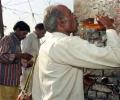
Since Bihar implemented its liquor prohibition law in April 2016, over 1.7 million people have been arrested for offences related to alcohol consumption and sale. The state's Prohibition, Excise and Registration Department reports high conviction rates and significant revenue collection despite the ban.

The Tamil Nadu government has mandated stringent quality testing across all distilleries in the state to ensure alcohol content compliance. This decision follows public concern over the temporary ban and swift clearance of products from a private manufacturer, Enrica Enterprises, by the state's liquor monopoly, TASMAC. The move aims to address suspicions and ensure public safety regarding alcoholic beverages.
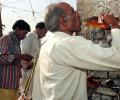
Two individuals have died and 19 others have been hospitalised in Gujarat's Bhavnagar district after consuming spurious liquor. Authorities have detained four bootleggers and are investigating the source of the duplicate Indian Made Foreign Liquor (IMFL) bottles, which are believed to have originated from Madhya Pradesh. Gujarat is a dry state where alcohol is banned.

Mizoram has long maintained one of the country's strictest prohibition regimes.

An intensified DVAC probe into a multi-crore liquor scam, allegedly involving former DMK Minister V Senthil Balaji, has led to a suggestion to privatise retail liquor sales in Tamil Nadu. The investigation targets alleged collusion in TASMAC bar licences, transport tenders, and procurement, with the Madras High Court dismissing Balaji's anticipatory bail plea. The FIR details systemic corruption, significant revenue loss, and illicit fund generation, prompting political reactions.
Two individuals have been arrested in Gujarat's Mehsana district for allegedly manufacturing liquor from a residential property, violating the state's strict prohibition laws.

Prohibition never stopped anyone from drinking in Gujarat. It only made the stories that come after a lot more interesting, recounts Binu Alex.

The Excise department in Thane seized 73,440 bottles of Goa-made Indian Made Foreign Liquor (IMFL) worth Rs 1.89 crore from a truck on the Panvel-Mumbra highway. The liquor, lacking batch numbers and MRP, is banned for sale in Maharashtra, leading to the driver's arrest under the Maharashtra Prohibition Act.

A spurious liquor tragedy in Gujarat's Bhavnagar district has resulted in eight deaths and left 61 persons affected, with 25 still undergoing treatment. Police have arrested 13 individuals in connection with the incident, which involved methanol-laced alcohol sold under a popular brand name. The State Monitoring Cell is investigating the source and distribution network of the illicit brew.
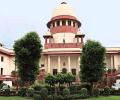
In a jolt to the Bihar government, the Supreme Court on Tuesday dismissed its batch of appeals challenging grant of anticipatory and regular bails to accused under the state's stringent liquor law, saying these matters have choked courts and 14-15 Patna high court judges are hearing these cases only.

The death toll due to the consumption of spurious liquor in Gujarat's Bhavnagar district went up to 13 on Sunday after two more victims succumbed during treatment, officials said.
Seven people have died and 30 others are hospitalised in Gujarat's Bhavnagar district after consuming spurious liquor. Police have detained 12 bootleggers and registered an FIR against 21 individuals. The victims reportedly consumed illicit liquor from duplicate bottles of an IMFL brand, with preliminary investigations suggesting the supply originated from Madhya Pradesh.

A research paper by the National Council of Applied Economic Research (NCAER) recommends that Bihar revoke its alcohol ban, citing its failure to reduce violence against women and a rise in illicit drug and alcohol consumption. The report suggests that reinstating the liquor excise tax would significantly increase state revenues and decrease enforcement costs.

Ladakh Lieutenant Governor Vinai Kumar Saxena on Sunday approved a new Excise Policy, permitting the sale of hard liquor through retail vends, reducing documents to obtain a licence from 16 to six and extending the liquor availability to four more districts.
Two individuals have been arrested in Navi Mumbai for allegedly smuggling Indian Made Foreign Liquor (IMFL) worth Rs 1.25 crore in a truck. The liquor was concealed under cement bags in a specially fabricated compartment.
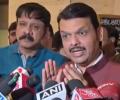
At least 13 people have died in Pune after consuming suspected spurious liquor, leading to multiple arrests and a high-level investigation.
At least 14 people have died in Pune after consuming suspected spurious liquor. Police have arrested eight individuals, including a key bootlegger, and the investigation has been transferred to the CID. The incident has sparked outrage and raised concerns about the illegal liquor trade.
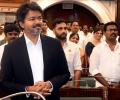
Tamil Nadu Chief Minister C Joseph Vijay has ordered the closure of 717 retail liquor outlets across the state, responding to public demand, particularly from women and political parties.
Maharashtra excise department seized Indian-Made Foreign Liquor (IMFL) manufactured in Goa, valued at Rs 1.43 crore, in Thane city and arrested two persons.

Prashant Kishor's Jan Suraaj Party reiterated its promise to scrap the liquor ban in Bihar if elected, planning to use the revenue to secure loans from international financial institutions.

A clash occurred between Excise & Prohibition Department officials and GRP personnel at Katihar railway station in Bihar over a liquor raid, resulting in injuries and investigations by both sides.

The Bihar government has rejected demands to review its prohibition law, which has been in place for a decade, despite concerns raised by members of the ruling NDA about financial losses to the state.

The Maharashtra excise department seized Indian Made Foreign Liquor (IMFL) worth Rs 11.39 lakh in Palghar district, leading to the arrest of three persons. Three vehicles worth Rs 21 lakh were also seized in the operations.
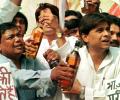
Uttar Pradesh police seized over 710 cartons of Indian-made Foreign Liquor (IMFL) worth approximately 1.20 crore in Chandauli, arresting two smugglers attempting to transport the contraband to Bihar, where alcohol is banned.

The JD(U) stated that it supported the BJP for the Bihar chief minister's post to reciprocate past support, as the new government prepares for a vote of confidence.
The Maharashtra Excise Department dismantled a major inter-state illicit liquor racket operating in Thane district, seizing contraband valued at Rs 32 lakh after conducting multiple raids.

A mob in Alirajpur, Madhya Pradesh, attacked a Gujarat police vehicle investigating a liquor smuggling case, fueled by local anger over a youth's death in Gujarat.

A group of seers, led by the Akhand Parshuram Akhada, has launched a campaign in Uttarakhand's Haridwar to ban the sale of food under the name "veg biryani".

Delhi Police arrested 16 criminals, including five women, and apprehended a juvenile during a 24-hour drive against illegal arms, illicit liquor, and narcotics in northwest Delhi.

At least 12 people have died in Pune and Pimpri Chinchwad after consuming suspected spurious liquor. Police have arrested eight individuals, including a key bootlegger, and investigations are ongoing to uncover the full extent of the illegal operation.
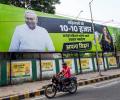
Voters are weighing a stark trade-off -- between preserving a socially driven policy and reversing course to revive revenue, restore fiscal balance, and rein in the underground liquor economy.
Eighteen people were arrested in Anand, Gujarat, for allegedly consuming alcohol at a party, violating the state's prohibition laws. The raid on a farmhouse led to the seizure of alcohol and vehicles.
As the election nears, political positions on prohibition are shifting.

The Delhi High Court has directed the city police to remove unauthorised recordings of court proceedings related to Arvind Kejriwal's plea from social media. This action follows a complaint against AAP leaders for sharing the clips.

Authorities in Tamil Nadu have seized 2.37 crore in cash, along with precious metals, liquor, and freebies worth crores, as part of election expenditure monitoring ahead of the upcoming Assembly elections.

An analysis of Nitish Kumar's tenure as Chief Minister of Bihar, highlighting his contributions to development and social justice alongside controversies and political shifts.
The latest move removes one of the key friction points for visitors, temporary liquor permits, while allowing licensed hotels and restaurants operational flexibility.

Fugitive businessman Vijay Mallya informed the Bombay High Court on Wednesday that he is unable to provide a definite timeline for his return to India, citing the revocation of his passport and also being legally barred from leaving the UK.

An amendment bill is likely to be tabled in the next session of the assembly in February.
